
Daddabha Jataka
Daddabha Jataka
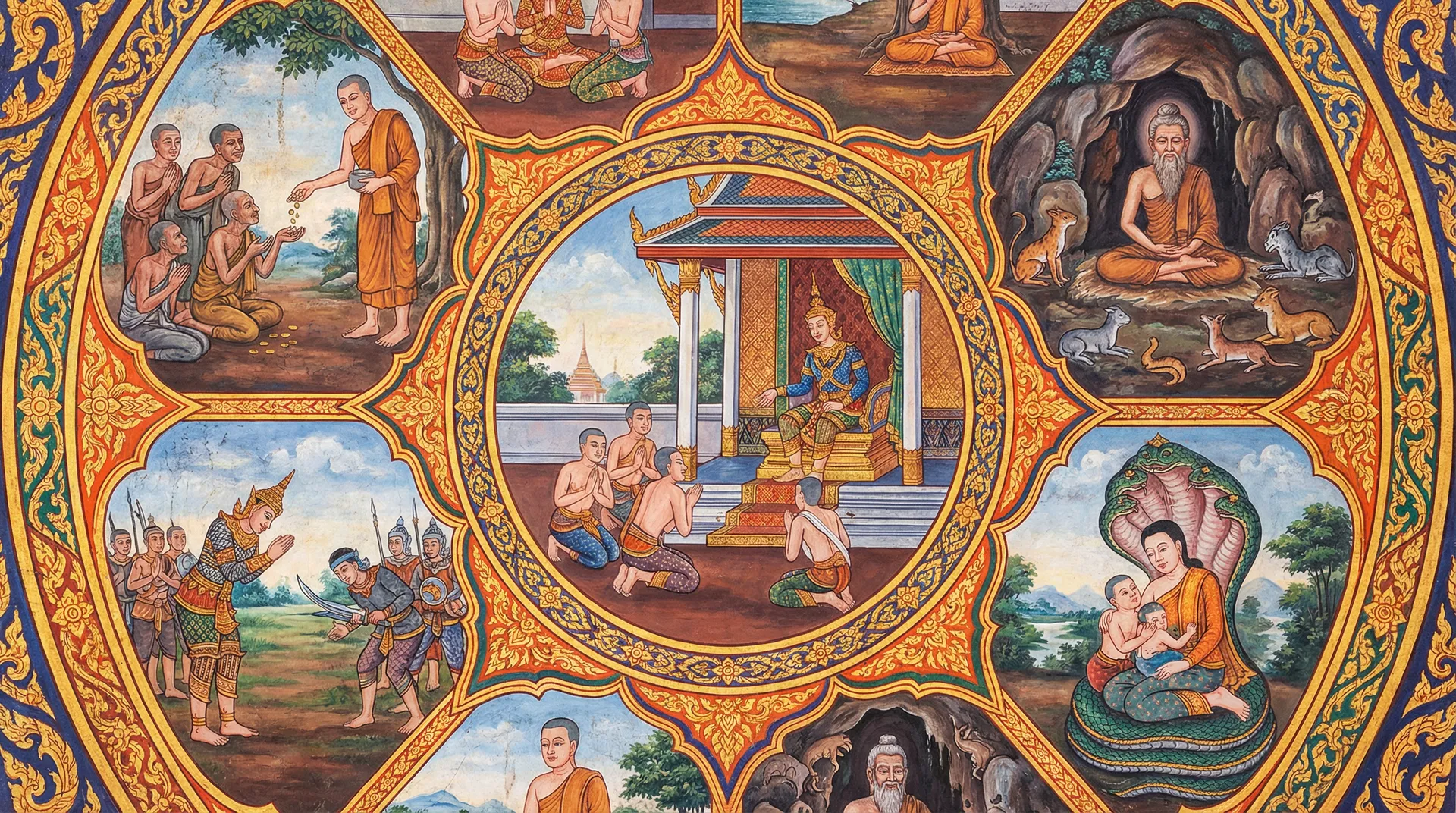
Long ago, in the kingdom of Kasi, where verdant plains met the shimmering waters of the Ganges, ruled a wise and benevolent king named Daddabha. His reign was marked by peace and prosperity, and the people adored him for his just governance. However, even the most peaceful kingdoms can harbor shadows, and in Daddabha's court, there was a minister named Kamsa, whose heart was as twisted as an ancient banyan root.
Kamsa was a man of sharp intellect but devoid of compassion. He harbored a deep-seated envy for the king's popularity and the respect he commanded. He saw the king's kindness not as a virtue, but as a weakness to be exploited. Kamsa's ambition was to usurp the king's throne, and he spent his days devising intricate schemes to achieve his goal.
One day, a delegation of merchants from a distant land arrived in Kasi, their caravans laden with exotic goods and tales of far-off wonders. Among them was a merchant named Vimala, a man of integrity and keen observation. Vimala, while conducting his trade, noticed the growing tension within the royal court. He observed Kamsa’s subtle manipulations and the way he subtly sowed seeds of doubt in the king’s mind regarding his loyal subjects.
The king, King Daddabha, was a man of great trust. He believed in the inherent goodness of his people and his advisors. Kamsa, knowing this, began to subtly poison the king's mind against his most loyal generals and advisors. He would whisper tales of imagined conspiracies, insinuate disloyalty where none existed, and twist innocent actions into acts of rebellion. The king, though initially dismissive, found Kamsa's persistent whispers gradually eroding his trust.
One evening, Kamsa approached the king with a particularly cunning plan. "Your Majesty," he began, his voice laced with feigned concern, "I have uncovered a plot. Your most trusted general, Valaka, along with several other high-ranking officials, are secretly plotting to overthrow you. They meet under the cloak of night, discussing your downfall."
The king, his heart sinking, asked, "How can you be so sure, Kamsa? Valaka has served me faithfully for many years."
"Your Majesty," Kamsa insisted, "I have spies who have overheard their treasonous discussions. Their loyalty is a facade. They are waiting for the opportune moment to strike." To solidify his lie, Kamsa presented fabricated evidence – forged letters and fabricated testimonies – to the king.
King Daddabha, though disturbed, was also a man of justice. He decided to investigate the matter himself before condemning his loyal men. He disguised himself, along with a few trusted, uncorrupted guards, and set out to observe Valaka and the other officials. He wanted to see for himself the truth of Kamsa's accusations.
Meanwhile, the Bodhisatta, in his past life as a wise sage living in a hermitage on the outskirts of Kasi, possessed the ability to perceive the true intentions of others. He sensed the malice brewing in Kamsa's heart and the king's growing distress. He knew that if Kamsa's deceit went unchecked, it would lead to the downfall of the kingdom.
The Bodhisatta, understanding the gravity of the situation, decided to intervene. He appeared at the royal palace just as the king was preparing for his clandestine observation. The king, recognizing the sage, bowed respectfully.
"Your Majesty," the Bodhisatta said, his voice calm and resonant, "why do you go out in such a manner? What weighs so heavily on your mind?"
The king, trusting the sage's wisdom, recounted Kamsa's accusations and his plan to verify them. He confessed his fear that his kingdom, built on trust, was being undermined by deceit.
The Bodhisatta listened patiently. Then, he spoke, "Your Majesty, the enemy you seek is not without, but within your own court. Kamsa, driven by envy and ambition, has woven a web of lies. He seeks to destroy those who are most loyal to you, so that he may stand alone in your favor and seize power. The evidence he presented is a fabrication, designed to mislead you."
The king was shocked. "But Kamsa has always been so devoted!"
"Devotion born of self-interest is a fragile thing, Your Majesty," the Bodhisatta replied. "True devotion is selfless and unwavering. Observe Kamsa's actions, not just his words. Does he seek the well-being of the kingdom, or his own aggrandizement? Does he speak ill of others behind their backs? These are the signs of a treacherous heart."
The Bodhisatta then advised the king. "Instead of observing Valaka and the others under suspicion, observe Kamsa himself. See who he meets with in secret, what plans he makes when he believes he is unobserved. The truth will reveal itself to an open and discerning mind."
Taking the Bodhisatta's counsel to heart, King Daddabha changed his plan. He instructed his guards to keep a close watch on Kamsa, not Valaka. The king, still in disguise, observed Kamsa from a hidden vantage point.
He saw Kamsa meeting secretly with known troublemakers and disgruntled elements from the city. He overheard Kamsa boasting about how he had successfully manipulated the king into distrusting his loyal men. Kamsa was planning to use the ensuing chaos to stage a coup.
The king, his heart filled with a mixture of anger and sorrow, realized the full extent of Kamsa's treachery. He returned to the palace and, with the Bodhisatta's guidance, confronted Kamsa with the evidence of his deceit.
Kamsa, exposed and cornered, could not deny his crimes. The king, though deeply hurt, acted with justice. Kamsa was stripped of his position and banished from the kingdom, his schemes thwarted.
The king then summoned General Valaka and the other officials, apologized for his temporary lapse in judgment, and reaffirmed his trust in them. The kingdom was saved from internal strife, and peace was restored.
King Daddabha, reflecting on the events, understood the Bodhisatta's profound wisdom. "You have taught me, holy one," he said, "that true loyalty is revealed not by outward displays, but by consistent actions for the good of all. And that a discerning mind, aided by wisdom, can see through the darkest of deceptions."
The Bodhisatta smiled. "Your Majesty, the greatest danger to any kingdom is not external invasion, but internal corruption and the blindness of its ruler. By seeking truth and acting with justice, you have preserved your realm and your people. Remember always to look beyond the surface and to trust those whose actions consistently reflect virtue."
The tale of Daddabha Jataka became a legend, a reminder that vigilance, discernment, and the courage to confront falsehood are essential for maintaining peace and justice, both in the realm of kings and in the chambers of one's own heart.
— In-Article Ad —
💡Moral of the Story
True loyalty is revealed through consistent actions for the good of others, and a discerning mind is crucial to uncovering deception and preventing internal strife.
Perfection: Wisdom (Panna)
— Ad Space (728x90) —
More Jataka Tales You May Enjoy
 207Dukanipāta
Mora Jataka
Mora Jataka In the heart of a dense, emerald forest, where ancient trees whispered secrets to the wi...
💡 Unity and courage, even from the smallest among us, can overcome the greed and malice of those who seek to harm the innocent. The power of a righteous plea can awaken the spirit of collective defense.
 363Pañcakanipāta
Kaccābu Jātaka
Kaccābu JātakaIn the ancient kingdom of Mithila, ruled by a benevolent king, there lived a Bodhisatt...
💡 Physical ailments are often a reflection of inner mental and emotional imbalances. Cultivating a calm, compassionate, and virtuous mind is essential for true healing and well-being, as it addresses the root causes of suffering rather than just its symptoms.
221DukanipātaDhammapala Jataka
Dhammapala JatakaIn the ancient kingdom of Varanasi, nestled beside the sacred Ganges, there lived a...
💡 True love and genuine intentions will always be revealed, and ultimately triumph over deceit and superficiality. Compassion and justice, when guided by truth, lead to the greatest happiness.
 134Ekanipāta
Sattubhatta Jataka
The Tale of the King Who Sought True Happiness In the ancient and prosperous city of Kasi, ruled a k...
💡 True and lasting happiness is an inner state, cultivated through self-understanding, mindfulness, detachment, and compassion, rather than being dependent on external circumstances or possessions.
81EkanipātaMāhāsukha Jātaka
Māhāsukha Jātaka Long ago, in the bustling city of Mithila, lived a king named Brahmadatta. He was a...
💡 True happiness is found not in external possessions or status, but in inner peace, detachment, and boundless compassion.
 424Aṭṭhakanipāta
Sarabhaṅga Jātaka
Sarabhaṅga JātakaIn the ancient land of Gandhāra, nestled amidst snow-capped mountains and whisperin...
💡 True peace is cultivated from within and achieved through understanding, compassion, and wisdom, not through violence or the imposition of power. Inner resilience is the greatest defense against external aggression.
— Multiplex Ad —